
Samuel Ward
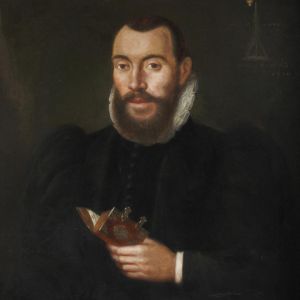
Samuel Ward
For thirty years the pulpit of St Mary-le-Tower belonged, almost without interruption, to one man. Samuel Ward mounted it as a young preacher in 1603 and did not truly leave it until the bishops who tried his conscience drove him first to a cell and then across the sea to Holland. His was one of the most vivid and most harried careers of pre-Civil-War English Puritanism — a man whose sermons reached thousands who never heard his voice, and whose one surviving engraving nearly cost him his liberty.
Born in 1577 at Haverhill, Suffolk, son of minister John Ward, Samuel was the elder brother of Nathaniel Ward, later author of The Simple Cobler of Aggawam and framer of Massachusetts’s first legal code. Nominated by Lord Burghley, he entered St John’s College, Cambridge, in 1594, and in 1599 was chosen one of the first fellows of the newly founded Sidney Sussex College. He proceeded M.A. in 1600 and, on his marriage to Deborah Bolton in 1604, vacated his fellowship, proceeding B.D. in 1607.
In November 1603 the corporation of Ipswich elected Ward Town Preacher, and he occupied the pulpit of St Mary-le-Tower for roughly the next three decades — a natural home for a preacher of his convictions in a prosperous, Puritan-leaning port town. His printed sermons, among them A Coal from the Altar and Balme from Gilead, went through repeated editions and carried his voice well beyond his own congregation.
“Is it not written, My house shall be called of all nations the house of prayer? but ye have made it a den of thieves.” (Inscribed on the wall of St. Mary-Le-Tower by Church Warden Ferdinando Adams, in Ward’s defense, 1636)
Ward’s convictions were not confined to the pulpit. In 1621 he designed an engraving, The Double Deliverance, setting the wrecked Spanish Armada beside the unmasked Gunpowder Plot, with the Pope, the King of Spain, and the devil in consultation at its center. Spain’s ambassador took it as a personal insult and complained to the Privy Council; Ward was examined and briefly imprisoned, after which he confined his skill as a designer to his own sermon title pages.
A Preacher Between Two Fires
The following two decades were a steady contest with the ecclesiastical authorities of his day. In 1622 Bishop Samuel Harsnett prosecuted him for nonconformity before the Norwich consistory court; Ward appealed to the king and was cleared through the intervention of Lord Keeper John Williams. In 1624 he complained to the House of Commons against the Arminian teaching of Richard Montagu, an early skirmish in the doctrinal battles that would consume the Church of England for a generation.
The final blow came from Archbishop William Laud. In November 1635 Ward was censured before the Court of High Commission for preaching against bowing at the name of Jesus and against the Book of Sports, and for warning that religion stood in imminent danger. He was suspended, ordered to recant publicly, fined, and imprisoned. His own townsmen refused to ask for a replacement, hoping Ward would be restored despite all censure.
On his release, Ward crossed to Holland and joined William Bridge’s English congregation at Rotterdam. But exile did not suit him long: in April 1638 he bought back his old Ipswich house and returned to the flock he had served since 1603. He died in March 1640 and was buried at St Mary-le-Tower, the church he had preached in for a generation.
Ward’s legacy is a preacher’s legacy. His collected Sermons and Treatises were published in nine parts in 1627–28, reprinted in 1636, and reissued in Edinburgh in 1862 under J. C. Ryle. Nearly three centuries after his death, the preacher of Ipswich was still read for the same plain, urgent godliness that had filled St Mary-le-Tower — and, more than once, filled a prison cell as well.
Writings
A Coal From The Altar (1615)
A call to kindle holy zeal, drawn from Revelation 3:19; went through at least four editions in Ward’s lifetime.
Balme from Gilead (1617)
A treatise on recovering a wounded conscience, edited for the press by Thomas Gataker.
The Life of Faith in Death (1621)
The dying speeches of faithful Christians, gathered as a comfort and example to the living.
More Puritan Summaries