
Thomas Cartwright
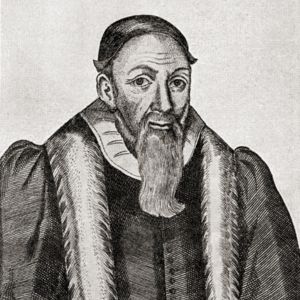
Thomas Cartwright was one of the earliest and most influential leaders of the English Puritan movement. Trained at Cambridge and recognized as a gifted theologian, Cartwright became convinced that the Church of England, while reformed in doctrine, still retained practices and structures not fully aligned with Scripture. His life reflects the Puritan conviction that the church must be shaped and governed by God’s Word alone.
A central focus of Cartwright’s teaching was biblical church government. He argued that the New Testament presents a model led by pastors and elders rather than bishops, drawing support from passages such as Acts 14:23, where elders are appointed in every church, and Titus 1:5, which describes the appointment of elders to lead local congregations. Cartwright believed that no human authority should rule over Christ’s church apart from what Scripture clearly commands (cf. Colossians 1:18).
Cartwright also emphasized the necessity of church discipline as an expression of love and faithfulness, not punishment. He taught that a healthy church must guard both doctrine and conduct, reflecting the pattern seen in Matthew 18:15–17 and 1 Corinthians 5:6–7, where correction serves the spiritual good of the body. For Cartwright, discipline helped preserve holiness and uphold the witness of the church.
Above all, Cartwright championed the supremacy and sufficiency of Scripture. He believed every element of worship, leadership, and practice should be tested by the Word of God, echoing 2 Timothy 3:16–17, which teaches that Scripture equips believers for every good work. Though his convictions led to suffering, imprisonment, and exile, Cartwright’s teachings helped lay the theological groundwork for later Puritan reform and shaped English-speaking Protestantism for generations.
Quotes
“The word of God is the rule by which all things in the church ought to be tried.”
“In the church of God there ought to be no lordship.” (cf. Mark 10:42–45)
“Discipline is no less necessary for the church than doctrine.” (cf. Hebrews 12:11)
Writings
A Reply to an Answer Made of M. Doctor Whitgift
The Second Reply of Thomas Cartwright (1575)
A Commentary upon the Book of Proverbs (published posthumously, 1617)