
Thomas Taylor
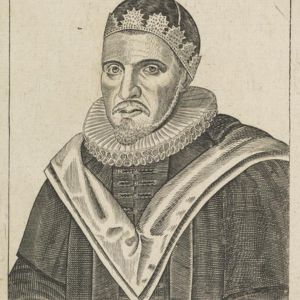
Thomas Taylor
A Brazen Wall Against Popery
Thomas Taylor was born in 1576 in Richmond, Yorkshire, into a household already marked by nonconforming sympathies. His father, recorder of the town, was known for a particular kindness toward ministers silenced for their scruples and toward exiles fleeing persecution in Scotland — a household, in other words, where the cost of Puritan conviction was not an abstraction but a fact of daily hospitality. It was in this atmosphere that the younger Taylor was formed, before he ever set foot in Cambridge.
He proved himself early at Christ’s College, Cambridge, where he was chosen fellow and served as reader in Hebrew. There he came under the influence of William Perkins, the great architect of English Reformed practical divinity, and absorbed both his theological method and his conviction that doctrine must issue in a rightly ordered life. Taylor began preaching at twenty-one, and by twenty-five had already delivered a sermon at St. Paul’s Cross before Queen Elizabeth herself — a mark of the reputation he was building as a preacher of unusual force. Admirers later said he stood “as a brazen wall against popery,” a description that captures both the substance and the temper of his pulpit work.
Silenced, Not Silent
In 1608, preaching at St. Mary’s, Cambridge, Taylor openly denounced Archbishop Richard Bancroft’s harsh treatment of Puritan nonconformists. The cost was immediate: he was silenced by Samuel Harsnet and threatened with degradation from his degree. What followed was some seventeen years without a settled benefice — a long season in which Taylor’s ministry depended on the protection and generosity of sympathetic patrons rather than on any ecclesiastical office. It was only after considerable hindrance that he was eventually able to proceed to his doctorate, a delay that traced directly back to his refusal to soften his 1608 sermon.
Rather than break him, the years of hindrance seem to have deepened Taylor’s pastoral seriousness. He was, by every surviving account, an indefatigable student and an exemplary man — Thomas Fuller numbered him among the learned writers of Christ’s College and called him “a grave divine,” noting his charity, his strictness of life, and his diligence in study. Edward Leigh called him simply “a solid and judicious divine.” These were not the epithets of a man merely tolerated for his learning, but of one whose life was reckoned to match his doctrine, even — as one early biographer put it — “his enemies being judges.”
Watford, Reading, and a Nursery of Preachers
By around 1612 Taylor was living at Watford, likely serving as vicar there, before removing to Reading, Berkshire, where his brother Theophilus Taylor would later pastor St. Lawrence Church for over two decades. It was at Reading that Thomas Taylor’s gifts as a teacher of teachers became most evident: a company of young preachers gathered around him, drawn by his learning and his example, forming what one account calls “a nursery of young preachers.” Among them was William Jemmat, who would go on to edit and preserve Taylor’s works for the generations that followed him.
Taylor’s later years brought him at last to a settled and prominent pulpit as preacher of Aldermanbury, London, where his reputation as “a famous and most elaborate divine” continued to grow through both his preaching and his prolific writing. He died in 1632, his final work — an exposition of the twelfth chapter of Revelation, published as Christ’s Victory over the Dragon — finished, in the words of its title page, “a little before his death.”
An Enduring Bridge
Taylor belongs to that generation of English Puritan divines who bridged the age of Perkins and the later Westminster Assembly — inheriting the plain-style, application-heavy preaching of his mentor and passing it forward, through his own writings and his circle of students, into the mainstream of seventeenth-century Reformed piety. Though less remembered today than contemporaries like Richard Sibbes or John Preston, his commentaries were long valued for their thoroughness, and his life stands as a case study in Puritan endurance: seventeen years without a pulpit, and yet no less faithful for the waiting.
Writings
More Puritan Summaries