
Joseph Hall
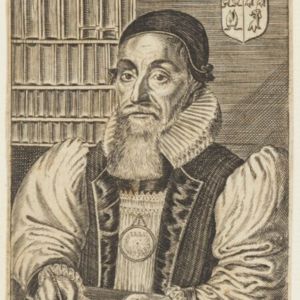
Joseph Hall
The bishop who wrote like a puritan.
Joseph Hall occupies an odd and instructive place in Puritan history: he wore a bishop’s rochet, yet he wrote with the warm, self-examining piety of the godly divines who distrusted bishops altogether. Raised by a devout mother and trained at Emmanuel College, Cambridge — the seedbed of Puritan learning — Hall carried the marrow of that piety into a long and often embattled career inside the established Church. Contemporaries could not decide whether he belonged to them or against them, and that very tension is what makes his life worth remembering.
But his delight is in the law of the LORD; and in his law doth he meditate day and night. Psalm 1:2
Hall took that verse, in effect, as a vocation. At a time when few Englishmen had written systematically on the devotional life, he produced The Art of Divine Meditation (1606) — one of the earliest manuals in the language teaching ordinary Christians how to meditate on Scripture with order and method. The book helped set a pattern that later Puritan writers such as Richard Baxter would follow and expand, making Hall, whatever his churchmanship, a genuine father of the Puritan meditative tradition.
Why Paul Baynes Matters
Several threads make Hall significant to the wider Puritan story. First, he was among the first English writers to give serious, practical shape to private meditation and self-examination — disciplines that became hallmarks of Puritan spirituality. Second, in 1618 King James sent him to the Synod of Dort, where he represented the Church of England among the Reformed delegations and pressed for charity between the parties even while holding to the doctrines of grace. Third, as Bishop of Exeter he was noted for dealing gently with Puritan clergy in his diocese, a leniency that drew suspicion from Archbishop Laud. And fourth, his later years supplied a living example of patient suffering: ejected from his palace at Norwich, his cathedral desecrated by an iconoclastic mob, and his revenues confiscated by Parliament, Hall retired to the village of Higham, where for roughly a decade he kept writing and preaching in poverty until his death.
His contemporary Thomas Fuller summed up Hall’s literary range memorably, calling him “our English Seneca” — a nod to Hall’s Christianized stoicism and to a style prized for its clarity and force across satire, controversy, and devotion alike.
In His Own Words
“No reasonable mind is so simple as not to better itself by secret thoughts.” – Joseph Hall
Hall wrote as a physician of souls, convinced that the inward, unseen work of the mind before God mattered as much as any outward duty. That conviction runs through nearly everything he produced, from his moral character-sketches to his sickbed reflections written in old age at Higham.
Quotes
“It is by meditation that we ransack our deep and false hearts, find out our secret enemies.”
“No resonable mind is so simple as not to better itself by secret thoughts”
Writings
The Art of Divine Meditation
A pioneering manual teaching believers a structured method for meditating on Scripture and divine truth — a direct forerunner of later Puritan meditative writing.
Heaven Upon Earth
A treatise on true peace and tranquillity of mind, blending classical moral philosophy with Christian comfort for the troubled conscience.
Characters of Vertues and Vices
The first English work in the classical “character” genre, sketching moral types in vivid miniature — a style later echoed throughout Puritan practical divinity.
More Puritan Summaries