
William Gouge
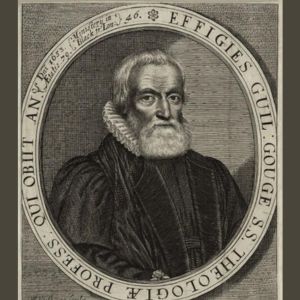
William Gouge
For forty-five years the same man stood in the same London pulpit, and London called him father for it. William Gouge began his ministry at St Ann Blackfriars in 1608 and did not leave it until his death in 1653 — a single, unbroken pastorate spanning the reigns of two kings, the rise of the Long Parliament, and the convulsions of civil war. His contemporaries styled him “the father of the London divines and the oracle of his time,” and the title was not flattery. Gouge’s steadiness was itself a kind of testimony: while lesser men were swept along by every theological and political current of early Stuart England, he remained at his post, expounding Scripture verse by verse to a congregation that grew too large for its building.
He was born at Stratford-le-Bow in Middlesex and baptized on the 6th of November, 1575, into a family of some standing. His schooling took him through Felsted, St Paul’s School, and Eton before he entered King’s College, Cambridge, where he took his B.A. in 1598 and his M.A. in 1601. He remained at Cambridge as a fellow and lecturer for several years, and it was there that he first showed the independence of mind that would mark his whole career — he stirred no small controversy by championing the logical method of Peter Ramus against the entrenched Aristotelianism of the university, a dispute that reportedly came near to riot among the students.
A Lifetime at Blackfriars
Gouge was not ordained until the age of thirty-two, late for a man of his learning, but once settled at Blackfriars in 1608 he never sought another charge. He came first as assistant to the aging Stephen Egerton and succeeded him as lecturer, building a ministry on the patient, systematic exposition of Scripture rather than on novelty or rhetorical display. His mid-week lectures became famous throughout the city, drawing hearers from well beyond the parish. Before admitting communicants to the Lord’s Supper he made a practice of visiting households himself, examining families together so that no one came to the table in ignorance of what they professed — a pastoral thoroughness typical of the man.
His convictions occasionally cost him. In 1621 he published, under his own name, Sir Henry Finch’s controversial work on the calling of the Jews, and the publication so displeased King James I that Gouge found himself briefly imprisoned for it. He weathered the episode as he weathered most things — without drama, and without swerving from his course.
Domesticall Duties
“No reasonable mind is so simple as not to better itself by secret thoughts.” – Joseph Hall
Hall wrote as a physician of souls, convinced that the inward, unseen work of the mind before God mattered as much as any outward duty. That conviction runs through nearly everything he produced, from his moral character-sketches to his sickbed reflections written in old age at Higham.
Westminster and Final Years
Though sixty-eight years old when the Long Parliament convened the Westminster Assembly in 1643, Gouge took his seat among the divines and remained an active participant in its work, lending to the Assembly the same unhurried thoroughness he brought to his pulpit. In 1647 he was appointed prolocutor of the Provincial Assembly of London. Even in these later years he continued preaching regularly at Blackfriars and laboring at what became his last and largest work, a massive commentary on Hebrews built from nearly a thousand sermons delivered over decades to his own congregation.
He did not live to finish it. Gouge died on the 12th of December, 1653, at the age of seventy-eight, with the closing chapters of the Hebrews commentary completed after his death by his eldest son, Thomas Gouge, himself a noted minister. As death approached, Gouge is reported to have said that death, next to Jesus Christ, was his best friend — for in dying he was certain to be with Christ, in whom alone, to the very end, he professed his rejoicing lay.
Quotes
“Jesus Christ, and what He hath done and endured, is the only ground of my sure comfort.“
“[I am] a great sinner, but I comfort myself in a great Savior.”
Writings
More Puritan Summaries