
Lewis Bayly
Lewis Bayly
The bishop who taught a nation to pray.
Few clergymen of the early seventeenth century occupied so curious a position as Lewis Bayly. He wore the rochet of a bishop, yet he wrote and lived like a Puritan, and it was this second identity, forged in the quiet discipline of personal devotion, that made his name outlast his office. Bayly rose through the Church of England’s establishment to become Bishop of Bangor, chaplain to the heir of the throne, and a man on easy terms with royal favor. But the book he wrote for his own congregation at Evesham became one of the most widely read works of practical divinity in the English language, carrying his voice into farmhouses, ships’ cabins, and prison cells long after his death.
Born around 1575 in Carmarthenshire, Bayly was educated at Oxford, where he was associated with Exeter College before proceeding to holy orders. His early ministry was spent in Evesham, Worcestershire, where he served as rector and, by his own account, grew troubled at how few of his parishioners possessed any settled habit of private prayer or self-examination. Out of that pastoral concern came the work for which he is remembered.
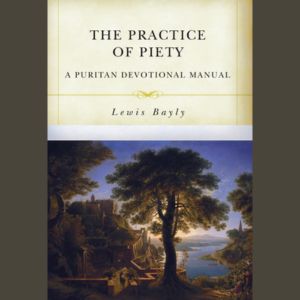
The Practice Of Piety
First published around 1611, The Practice of Piety: Directing a Christian How to Walk That He May Please God was an unassuming manual on the surface, a guide to morning and evening devotion, self-examination, and preparation for the Lord’s Supper and for death. Yet its plain, orderly method of walking a soul through an entire day, and an entire life, in the presence of God struck a chord that few devotional works of the era matched. It went through dozens of editions within a few decades, was translated into Welsh, French, German, Hungarian, and Polish among other tongues, and became a staple of household piety across the Protestant world.
Its influence reached further than most of Bayly’s episcopal contemporaries could have imagined. John Bunyan later recalled that his own first wife brought only two books into their marriage: Arthur Dent’s The Plain Man’s Pathway to Heaven, and Bayly’s Practice of Piety. The book’s rhythms of daily self-examination and its plain insistence that true religion was a matter of the heart, not merely of ceremony, place it squarely within the devotional tradition that Puritan writers such as Richard Baxter and Richard Rogers were cultivating in the same years, even though its author sat on the episcopal bench.
Bishop and Nonconformist
In 1616 Bayly was appointed a royal chaplain and tutor to Prince Henry, and in 1616 he was consecrated Bishop of Bangor, a Welsh see that gave him oversight of a diocese not far from his own roots. His tenure there was not without friction. Bayly’s Puritan sympathies, his plain preaching, and his resistance to certain ceremonial demands placed him at odds with more conformist churchmen, and he was, at points, called before ecclesiastical authorities and even briefly imprisoned over disputes tied to preaching licenses and opposition to royal policy on Sabbath observance. He was, in short, a bishop who never fully comfortable inside the institutional skin he wore.
This tension, a churchman by office and a Puritan by temperament, was not unusual for the period, but Bayly’s case is notable for how completely his devotional writing outlived his ecclesiastical controversies. Few remember the disputes over his diocese; many more, across four centuries, have opened The Practice of Piety to guide their own private prayer.
“Enter thou into thy closet, and when thou hast shut thy door, pray to thy Father which is in secret.” Matthew 6:6
That verse might well serve as the epigraph for Bayly’s entire project. His method of piety was built around the quiet, unseen discipline of the individual soul before God, precisely the kind of interior religion that the wider Puritan movement sought to cultivate in a nation still working out what the Reformation meant for ordinary life.
Quote
He that would die well, must always look to live well; for such as a man’s life is, such commonly is his death.
Writings
The Practice Of Piety (1611)
Theophilus and Philodoxus
More Puritan Summaries