
William Ames
William Ames
The Conscience of New England Divinity.
William Ames never set foot in New England, yet no theologian shaped its mind more thoroughly. Born in Ipswich in 1576 and orphaned young, he was raised by a Puritan uncle and sent to Christ’s College, Cambridge, where he came under the preaching of William Perkins. That encounter set the direction of his life: a rigorous, practical divinity aimed not at speculation but at godly living.
Ames’ nonconformity made England increasingly inhospitable. His refusal to wear the surplice and his outspoken opposition to gaming and drunkenness among students drew the ire of university and church authorities alike. By 1610 he had left for the Netherlands, the great refuge of English Puritans, where he would spend the rest of his life — first at The Hague, then at Franeker, where he held the chair of theology for over a decade.
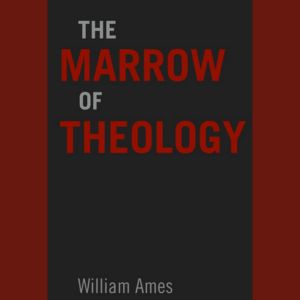
At Franeker, Ames produced the work for which he is remembered: the Medulla Theologiae, or Marrow of Theology, first published in 1623. It reduced Reformed doctrine to a compact, logically ordered handbook, opening with a definition that would echo through generations of students:
“Theology is the doctrine or teaching of living to God.” – The Marrow of Theology
That single sentence captured Ames’s whole project. For him theology was never mere contemplation — it was inseparable from practice, aimed always at the transformed life. This conviction shaped his second major work, Conscience with the Power and Cases Thereof, a manual of practical divinity that walked believers through the moral dilemmas of ordinary life with pastoral precision.
On sanctification, Ames was equally direct, describing the believer’s transformation in terms of a real and ongoing change rather than a legal fiction: “Sanctification is the real change in man from the sordidness of sin to the purity of God’s image.” – The Marrow of Theology
He wrote just as plainly about contentment, a theme that ran through much Puritan devotional literature but which Ames grounded firmly in providence: “The virtue of contentment is the acquiescence of the mind in the lot God has given.” – The Marrow of Theology
The Marrow crossed the Atlantic long before any Puritan colonist did. It became a standard textbook at Harvard, read in Latin by undergraduates as the backbone of their theological training, and both Thomas Hooker and Increase Mather counted it, after Scripture, the one book a student truly needed. Some accounts even suggest Ames was considered for Harvard’s presidency — an offer that never reached him before his death at Rotterdam in 1633, still in exile, never having seen the New World his thought would come to govern.
Writings
The Marrow of Theology (1623)
Conscience with the Power and Cases Thereof (1630)
More Puritan Summaries