
Nicholas Byfield
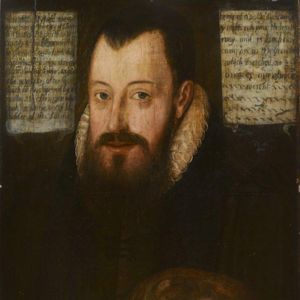
Nicholas Byfield was born in Warwickshire in 1579, the son of Richard Byfield, later minister of Stratford-upon-Avon. He entered Exeter College, Oxford, in 1596, and spent four years there without taking a degree, a hard student who preferred the discipline of study to the credential. Taking orders, he set out for Ireland, intending to give his ministry to that field. He never arrived. Preaching at Chester on the way, he was pressed to stay, and remained as a lecturer at St Peter’s, without formal cure of souls but with a popularity that filled the church.
Among his hearers at Chester was the godly layman John Bruen, who became a lasting friend. Byfield’s preaching there was marked by the plain, doctrine-and-use method common to the Puritan pulpit, and it drew a following well beyond the ordinary congregation.
In 1615 Byfield was admitted vicar of Isleworth in Middlesex, succeeding Thomas Hawkes, and served also as chaplain to Edward Russell, third Earl of Bedford. There he preached twice every Lord’s day and gave expository lectures each Wednesday and Friday, a punishing rhythm he kept for fifteen years despite chronic suffering from the stone. He laid down his public labors only five weeks before his death.
Byfield died on Sunday, 8 September 1622, at not quite forty-three years of age. The next day a surgeon removed from his body a stone of some thirty-five ounces, an ordeal recorded in the inscription beneath his portrait, which still hangs in Dr Williams’s Library. He left a wife, Elizabeth, and at least eight children, among them Adoniram Byfield, who would later serve as a scribe to the Westminster Assembly.
His writing matched his preaching in its industry. His commentary on the first epistle of Peter, his exposition of Colossians, and his treatise on the Sabbath were widely read and reprinted, and William Gouge, who attended his autopsy, later prefaced one of his posthumous works. Contemporaries remembered him for sound judgment and quick invention as much as for learning, a preacher whose body failed him long before his mind or his diligence did.
Why He Matters
- A best-selling commentator – His expositions of 1 Peter and Colossians went through repeated printings well into the century, giving ordinary readers sustained access to verse-by-verse Puritan exegesis outside the pulpit.
- A model of the disciplined pastorate – Twice-weekly lectures alongside two Sunday sermons, sustained for fifteen years through chronic illness, embodied the Puritan ideal of the preaching ministry as relentless, methodical labor rather than occasional performance.
- A node in the movement’s network – His friendship with the lay Puritan John Bruen at Chester and his connection to William Gouge, who prefaced his posthumous work, place him inside the web of relationships that gave English Puritanism its coherence.
- Father to the next generation – His son Adoniram Byfield served as a scribe of the Westminster Assembly, carrying the family’s influence directly into the drafting of the Westminster Standards a generation later.
Writings
A Commentary Upon 1 Peter
An Exposition of Colossians
The Cure of the Fear of Death
More Puritan Summaries