
John Robinson
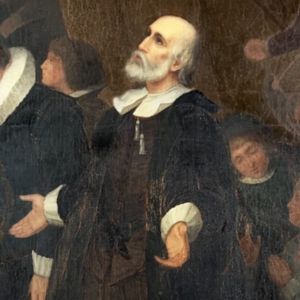
John Robinson
Pastor To The Pilgrims
John Robinson never set foot in America, yet no figure did more to shape the congregation that sailed on the Mayflower. Born in Lincolnshire and educated at Corpus Christi College, Cambridge, he was ordained in the Church of England and for a time held a curacy near Norwich, where his Puritan sympathies soon put him at odds with his bishop.
By around 1606 Robinson had concluded that the established church could not be reformed from within, and he cast his lot with the Separatists who worshipped outside it at their peril, joining the congregation gathering secretly at Scrooby under William Brewster. Discovery and harassment by church authorities drove the group first to hiding, then to flight.
The congregation crossed to the Netherlands around 1608 and settled the following year in Leiden, a city known for its tolerance and its university. There Robinson served as pastor for over a decade, and his standing grew well beyond his own flock: he earned a doctorate from Leiden University and was respected among Dutch Reformed theologians for his learning, even while his people lived as poor exiles working the textile trades to survive.
By 1617, economic hardship and worry over losing their English identity in a Dutch city led part of the congregation to consider a further move, this time across the Atlantic. Robinson helped negotiate the arrangements but, as pastor of a congregation too large to transplant all at once, he stayed in Leiden with the majority, sending the younger and more able members ahead under the eldership of Brewster. He intended to follow once the colony was established.
He never did. Robinson died in Leiden in March 1625, five years after the Mayflower sailed, having never seen the Plymouth colony his people founded. Before their departure he gave the group a farewell charge that outlived him: an appeal to remain open to further light breaking forth from Scripture, and not to treat the Reformation, or any human system, as a finished work.
That charge became his enduring legacy — a Separatist conviction tempered by an unusual humility toward ongoing reform, still quoted wherever Christians weigh inherited tradition against the possibility that God has more to teach his church.
Writings
by Timothy George
by William Bradford
More Puritan Summaries