
John Davenant
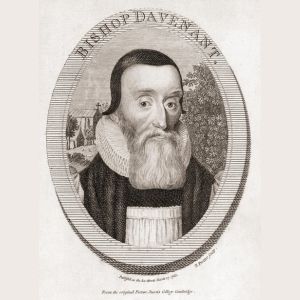
John Davenant: Bishop, Scholar, and Guardian of Grace
The moderate Calvinist who shaped an age of controversy
Born in London in 1572, John Davenant entered Queens’ College, Cambridge, at fifteen and rose to become its President by 1614. Along the way he earned the Lady Margaret Professorship of Divinity — England’s most distinguished theological chair — and was ordained into the Church of England. He was, by any measure, one of the finest Reformed minds of his generation.
The Synod of Dort, 1618
Davenant’s fame rests above all on his role as one of five delegates chosen by King James I to represent England at the Synod of Dort, where Protestant Europe gathered to answer the Arminian controversy. He distinguished himself on the doctrine of the atonement, arguing that Christ’s death was sufficient for all mankind in a real and intentional sense, while its saving benefit was secured only for the elect — a position now called “hypothetical universalism” that continues to draw scholarly debate.
Bishop of Salisbury
Returning from Dort with his reputation greatly enhanced, Davenant was appointed Bishop of Salisbury by King James I in 1621. Though he wore the vestments of the episcopate, his theology was thoroughly Reformed and his spirit was irenic toward Puritan nonconformists — men who, in stricter dioceses, faced silencing. He was trusted by king and Puritan alike, a bridge between the established church and those pressing for further reformation.
Why He Matters
John Davenant died on 20 April 1641, just months before the Long Parliament began to dismantle the episcopacy he had served. His legacy is the rarer achievement: deep Reformed conviction held with a peaceable spirit. Historian William Cunningham called his work on predestination the finest vindication of the Calvinist doctrine ever produced. Spurgeon admired his commentary. And his Treatise on Justification remains, centuries on, a landmark of English Reformed theology — in print once more, for those who hunger for learning that is both rigorous and warm.
Quotes
“Such is the admirable operation of the Almighty, in effecting the salvation of the predestined, that He allows their will to act of its own accord, that is contingently; and yet He Himself brings about their salvation infallibly.”
“It demonstrates also the infinite love of God towards the human race, who willingly sent his own Son to redeem miserable mortals. Let this inflame us with reciprocal love; let this excite us to every kind of obedience.”
“In many places the work of reconciliation is ascribed to God the Father — God was in Christ, reconciling the world unto himself. He who extols Christ the Redeemer at the same time extols the Father who sent him, and the Holy Spirit who renders this redemption efficacious to all the elect and believers.”
Writings
An Exposition of the Epistle of St. Paul to the Colossians
A Treatise on Justification
A Dissertation on the Death of Christ
More Puritan Summaries