
John Boys
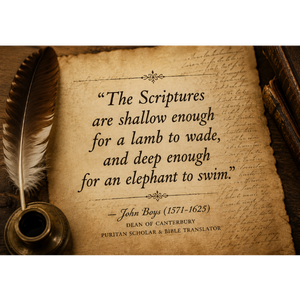
Forgotten Giant of the Pulpit: John Boys (1571–1625)
A Man Who Lived Among His Books — and Died Among Them Too
Who Was John Boys?
In an era crowded with theological giants — Perkins, Preston, Sibbes, and Goodwin among them — the name John Boys does not always leap from the page. Yet in the early seventeenth century, few men did more to bring careful scriptural exposition into the hands of ordinary English clergy and laypeople than this quiet, industrious Dean of Canterbury.
Born in Eythorn, Kent, in 1571, Boys came from a distinguished Kentish family with deep roots in the region. He received his early education almost certainly at the King’s School, Canterbury, before entering Corpus Christi College, Cambridge in 1586 — the very college where Archbishop Matthew Parker had established scholarships for Kentish scholars. He later migrated to Clare Hall, where he was elected fellow, and proceeded to his Doctor of Divinity in 1605.
His first clerical appointment was the small rectory of Betteshanger — obtained through the patronage of his uncle, Sir John Boys of Canterbury — and it was there that he threw himself into the art and discipline of preaching. He was only twenty-seven years old when he was called to preach at the celebrated St Paul’s Cross in London, one of the most prominent open-air pulpits in all of England. Remarkably, it was during his second sermon at that very spot that the Earl of Essex launched his ill-fated rebellion (February 1601) — Boys kept preaching.
Why Boys Matters in Puritan History
John Boys occupies a fascinating and often misunderstood place in the story of English Puritanism. Strictly speaking, he was a committed Anglican churchman — a defender of the Church of England’s liturgy, its forms, and its episcopal structures. Yet his deep, verse-by-verse engagement with Holy Scripture, his earnest application of the Word to the soul, and his prolific output of biblical exposition place him squarely within the broader Reformed and Puritan tradition of his age.
Here are the key reasons he remains historically significant:
1. The Great Expositor of the English Liturgy
Boys’s defining contribution was a series of massive works systematically expounding the Epistles and Gospels appointed in the Book of Common Prayer. At a time when many clergy barely understood the lectionary texts they read aloud each Sunday, Boys gave them — and their congregations — rich, learned, and pastoral commentary. His Exposition of the Dominical Epistles and Gospels (1609) was an immediate sensation, going through multiple editions in rapid succession.
2. A Bridge Between Church and Scripture
Boys believed passionately that the Church of England’s liturgy was scripturally grounded, and he set out to prove it. His works were not dry academic exercises but living demonstrations that the Prayer Book led people to the heart of the Bible. In doing so, he helped legitimize Reformed preaching within Anglican structures, occupying middle ground at a time when the Church was under pressure from both Rome and radical nonconformity.
3. Unmatched in Quotation and Learning
One admiring historian noted that “no writer of the seventeenth century quotes so widely and so frequently from contemporary literature as Boys” — drawing not only from theology but from popular writers, proverbs, and the customs of everyday English life. His pages reference Francis Bacon’s Essays, Piers Plowman, and the epigrams of More and Owen alongside the Church Fathers. He was a man of enormous learning worn lightly.
4. Patronage by the Archbishops of Canterbury
Boys enjoyed the successive favor of Archbishop Whitgift, Archbishop Bancroft, and Archbishop Abbot — three of the most powerful ecclesiastical figures of the age. This chain of patronage tells us much: serious churchmen recognized in Boys a scholar and preacher of the first rank. He was ultimately elevated to the Deanery of Canterbury in 1619 by King James I himself, one of the most prestigious positions in all of English church life.
5. A Lasting Legacy Beyond England
Though Boys fell from fashion after his death — his uncompromising Anglicanism sitting awkwardly with the rising Puritan and Presbyterian movements — his works crossed the English Channel. They were translated into German and published at Strasburg in 1683 and again in 1685, a remarkable testament to their enduring value on the European continent. In 1997, Soli Deo Gloria Publications reprinted his collected works for a new generation of Reformed readers.
A Final Portrait
In September 1625 — the same year plague swept through England and a new king, Charles I, had barely settled onto his throne — John Boys died suddenly in Canterbury, surrounded by his beloved books. He had just preached before the king and his new French queen only months before. He left no children. His widow outlived him into the years of the great rebellion that would tear England apart.
His life was, in many ways, a microcosm of his age: a scholar-pastor caught between the competing forces of Reformation and tradition, popular preaching and learned exposition, royal patronage and spiritual conviction. He was not a firebrand. He was something rarer — a man who believed that faithful, patient, thorough engagement with Scripture was itself a revolutionary act.
In an age that desperately needs just such men and women, John Boys deserves to be remembered.
Quotes
“The world is a huge theater or stage, wherein some play the parts of Kings; others, of Bishops; some, Lords; many, Knights… but when our Lord shall come with his Angels to judge the world, all are alike.”
“He is the best physician that best knows the disease.” – on the necessity of understanding human sin before applying the remedy of grace
“The Scriptures are the rule of faith; the ancient councils the rule of order.” – on the proper relationship between Scripture and church tradition
Writings
The Minister’s Invitatorie – Boys’s debut publication – The title reveals his pastoral heart — he conceived of the minister’s role as one of invitation, drawing the congregation deeper into the Word of God through careful, welcoming exposition.
An Exposition of the Dominical Epistles and Gospels – he work that established his reputation across England. Covering the Sunday Epistles and Gospels of the liturgical year, this volume supplied “a great need,” as contemporaries recorded, and achieved rapid, wide sales through successive new editions. It remained a standard reference for Anglican clergy for decades.
An Exposition of the Festival Epistles and Gospels – A companion to his earlier work, this two-part volume addressed the Epistles and Gospels appointed for the great festivals of the church year — Christmas, Easter, Pentecost, and the feasts of the saints. Dedicated to Archbishop Abbot, it completed a monumental project: a comprehensive expository guide to the entire lectionary of the Church of England.
More Puritan Summaries